
Company Domicile Switzerland: Legal Impact and Tax Benefits
- Jan 13
- 8 min read
Updated: Jan 19

Most American technology and finance leaders are surprised to learn that Switzerland demands more than a simple business address for company domicile status. Establishing a Swiss base is a strategic move for foreign entrepreneurs, but the rules for GmbH or AG formation require genuine operational presence and legal clarity. This article unpacks how Swiss regulations define true company domicile, helping decision makers avoid costly mistakes and maximize both tax efficiency and global credibility.
Table of Contents
Key Takeaways
Point | Details |
Company Domicile Definition | A company domicile in Switzerland is not just a registered address but the actual center of economic activities and management requiring proof of genuine operations. |
Types of Domiciles | Swiss law distinguishes between registered domicile, effective management domicile, and economic activity domicile, each carrying specific legal implications. |
Registration Requirements | Establishing a company in Switzerland involves comprehensive legal documentation, including proof of capital and compliance with local governance standards. |
Tax Implications | The choice of domicile affects tax obligations and benefits, making it critical to consider location strategically for optimal tax positioning. |
Company domicile Switzerland: Core definition
A company domicile represents the legal and operational headquarters of a business entity, defining its core location for administrative, tax, and regulatory purposes. In Switzerland, this concept goes far beyond a simple registered address, encompassing the actual center of economic activities and strategic management. Company domicile in Switzerland requires substantive proof of genuine business operations within the country.
The Swiss legal framework distinguishes between nominal and authentic company domiciles by evaluating critical factors such as effective management, primary business activities, and substantial economic presence. This means that merely registering an address does not automatically constitute a legitimate Swiss company domicile. Companies must demonstrate meaningful operational connections, including active decision making, financial transactions, and strategic planning conducted within Swiss territory.
Key elements determining a legitimate Swiss company domicile include the location of executive leadership, primary business activities, financial record keeping, and the primary site of corporate governance. Swiss authorities meticulously examine these factors to ensure that companies claiming Swiss domicile genuinely contribute to the national economic ecosystem. International entrepreneurs must understand that establishing a domicile involves comprehensive documentation, legal compliance, and a verifiable economic footprint.
Pro tip: When establishing a Swiss company domicile, work with local legal experts who can help navigate the nuanced requirements and ensure your business meets all regulatory standards for authentic corporate registration.
Types of company domicile and distinctions
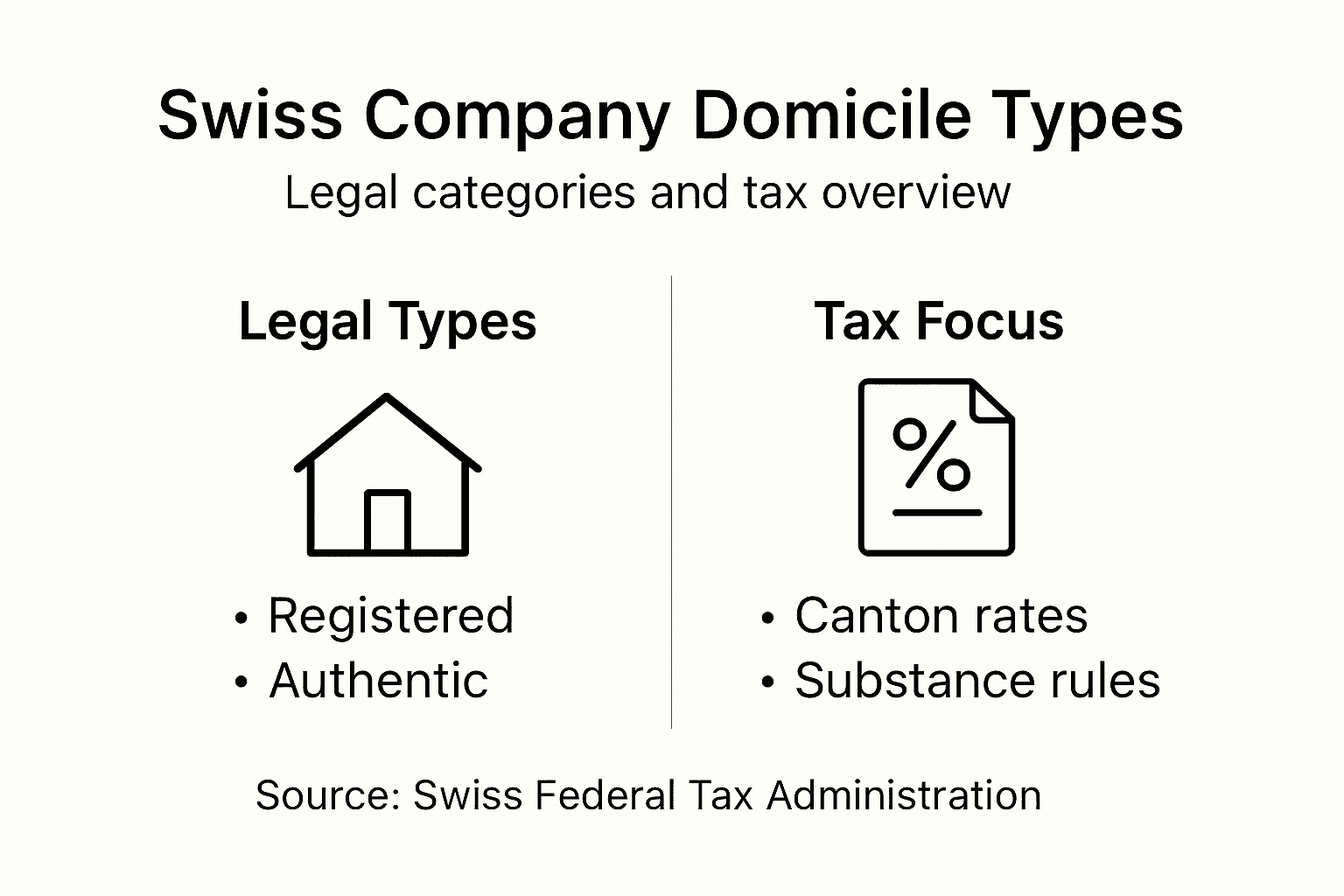
Swiss corporate law recognizes multiple nuanced types of company domiciles, each with distinct legal and operational implications. Operational origin and management distinctions play a critical role in determining a company’s authentic domicile status. The primary classifications include registered domicile, effective management domicile, and economic activity domicile.
The registered domicile represents the official address legally documented in commercial registers, which serves as the company’s primary administrative location. However, this does not automatically guarantee recognition as a genuine Swiss company. The effective management domicile represents a more substantive classification, focusing on where key strategic decisions are made, corporate governance occurs, and executive leadership is physically situated.
Another critical distinction involves the economic activity domicile, which examines the actual economic substance and operational footprint within Switzerland. This classification requires demonstrable evidence of substantial business activities, financial transactions, employee presence, and meaningful economic contributions to the Swiss business ecosystem. International companies must carefully navigate these distinctions to establish a legitimate and legally compliant corporate presence.
Pro tip: Consult specialized Swiss corporate legal experts to conduct a comprehensive assessment of your company’s domicile status, ensuring alignment with complex regulatory requirements and avoiding potential legal complications.
Here’s a comparison of the main types of Swiss company domiciles and their distinct characteristics:
Domicile Type | Core Focus | Legal Impact | Typical Requirements |
Registered Domicile | Official address | Administrative recognition | Commercial register documentation |
Effective Management Domicile | Strategic decision-making | Substantive corporate governance | Executive presence, leadership |
Economic Activity Domicile | Operational footprint | Tax and regulatory compliance | Economic substance, employee base |
Legal requirements for Swiss registration
Registering a company in Switzerland involves a comprehensive and meticulously regulated process that demands strict adherence to legal protocols. Commercial register requirements serve as the foundational framework for establishing a legally recognized business entity. International entrepreneurs must navigate a complex landscape of administrative procedures, documentation standards, and regulatory compliance to successfully incorporate their businesses.

The legal registration process encompasses several critical steps, including selecting an appropriate company structure (such as AG or GmbH), drafting comprehensive company statutes, and meeting specific capital subscription requirements. Entrepreneurs must provide detailed documentation including proof of initial capital, identification of company founders, proposed business activities, and a legally compliant company name. Swiss authorities require precise information about the company’s governance structure, including details about directors, shareholders, and the proposed business scope.
Key legal requirements for Swiss business registration involve multiple administrative checkpoints. Businesses must submit official documentation to the Commercial Register, including notarized company statutes, proof of initial capital deposit, and comprehensive information about the company’s organizational structure. Foreign entrepreneurs must also demonstrate compliance with Swiss corporate governance standards, including appointing local representatives, establishing a valid business address, and fulfilling initial tax registration obligations.
Pro tip: Engage a specialized Swiss corporate registration consultant who understands the intricate nuances of local regulatory requirements to streamline your company registration process and avoid potential administrative complications.
Tax implications of domicile location
The choice of company domicile in Switzerland carries profound tax implications that can significantly impact an organization’s financial strategy. Tax treaty provisions play a critical role in determining the fiscal treatment of international businesses, with specific residency definitions influencing overall tax obligations. The location of a company’s domicile directly affects its effective tax rate, reporting requirements, and potential benefits from bilateral tax agreements.
Corporate tax rates vary dramatically across different Swiss cantons, creating strategic opportunities for businesses to optimize their tax positioning. Companies with an effective domicile in low-tax cantons like Zug or Schwyz can benefit from significantly reduced corporate tax rates, sometimes as low as 8-12%. This territorial taxation approach allows companies to minimize their overall tax burden by carefully selecting their domicile location, considering factors such as cantonal tax rates, administrative infrastructure, and proximity to key business networks.
International businesses must navigate complex regulations surrounding tax residency, which extend beyond simple geographical location. The Swiss tax authorities evaluate multiple factors including the company’s actual management location, primary economic activities, and substantial business presence. Foreign entrepreneurs must demonstrate that their company’s domicile represents a genuine economic substance, not merely a tax optimization strategy. This requires maintaining comprehensive documentation, establishing real operational connections, and ensuring transparent financial reporting that meets Swiss regulatory standards.
Pro tip: Conduct a comprehensive tax analysis with specialized Swiss tax consultants to understand the nuanced tax implications of your specific company domicile, ensuring optimal financial positioning and full compliance with Swiss fiscal regulations.
Domicile vs. permanent establishment differences
Understanding the nuanced legal distinction between company domicile and permanent establishment is critical for international businesses operating in Switzerland. Tax treaty definitions provide a precise framework for differentiating these two complex corporate concepts. While both terms relate to a company’s operational presence, they carry significantly different legal and tax implications.
A company domicile represents the legal headquarters where strategic management and primary decision making occur, typically determined by the location of executive leadership and central administrative functions. In contrast, a permanent establishment refers to a fixed place of business through which a company conducts substantial economic activities. This might include a physical office, workshop, factory, or installation where regular business operations are systematically performed. The key differentiator lies in the depth and consistency of business activities conducted at a specific location.
The tax consequences of these distinctions are profound. A permanent establishment triggers specific tax obligations in the jurisdiction where it operates, potentially creating complex reporting requirements and tax liabilities. Swiss tax authorities meticulously evaluate the substantive economic activities, duration of operations, and degree of business independence to determine whether a location qualifies as a permanent establishment. International companies must carefully document their operational structures to ensure compliance with Swiss tax regulations and avoid unexpected financial complications.
Pro tip: Consult specialized Swiss tax professionals to conduct a comprehensive analysis of your company’s operational structure, clarifying the precise legal status of your domicile and potential permanent establishments.
Common pitfalls and compliance risks
International entrepreneurs face numerous complex challenges when establishing a company domicile in Switzerland, with significant legal and financial risks lurking in regulatory nuances. Company domicile compliance risks extend far beyond simple administrative procedures, encompassing intricate legal and reputational considerations that can dramatically impact business operations.
One critical pitfall involves misrepresenting the company’s actual operational presence. Merely registering a Swiss address without demonstrating genuine business activities can lead to severe consequences, including potential legal sanctions, tax complications, and loss of credibility. Swiss authorities rigorously scrutinize companies claiming Swiss domicile, examining factors such as substantive economic activities, management location, financial transactions, and the depth of operational connections within the Swiss business ecosystem.
Additional compliance risks stem from complex licensing requirements that vary across different Swiss cantons. Foreign companies must navigate intricate professional qualification recognition processes, understand sector specific regulatory frameworks, and ensure complete alignment with local business regulations. Potential penalties for non compliance can include substantial financial fines, legal restrictions on business activities, and potential permanent barriers to operating within the Swiss market. International entrepreneurs must invest significant effort in understanding and meticulously implementing Swiss regulatory standards.
Below is a summary of common Swiss company domicile compliance risks and business impacts:
Compliance Risk | Typical Cause | Potential Impact | Mitigation Approach |
Insufficient economic activity | Only registered address, no real operations | Legal sanctions, tax issues | Establish actual business presence |
Incomplete licensing | Unawareness of cantonal regulations | Business restrictions | Consult local legal experts |
Inaccurate documentation | Errors in official filings | Financial penalties | Maintain rigorous document checks |
Misrepresented management | Executive not located in Switzerland | Loss of credibility, fines | Base leadership locally |
Pro tip: Engage specialized Swiss legal consultants to conduct a comprehensive compliance audit before establishing your company domicile, ensuring full alignment with regulatory requirements and mitigating potential operational risks.
Unlock the Full Potential of Your Swiss Company Domicile with Expert Support
Navigating the complex legal and tax implications of establishing a company domicile in Switzerland requires clear guidance and reliable expertise. The challenges of proving genuine economic activity, meeting regulatory compliance, and optimizing canton-specific tax benefits can be overwhelming. Do not let administrative hurdles or compliance risks hold back your international business ambitions. With the right partner, you can confidently secure a legitimate Swiss company domicile that aligns with your strategic goals.

Take control of your Swiss incorporation journey today by partnering with RPCS. From drafting legal documentation and notarization to commercial registration and banking setup, RPCS specializes in helping global entrepreneurs conquer the intricacies of Swiss company formation. Benefit from tailored advice on structuring your company to maximize favorable tax regimes and ensure full compliance with Swiss authorities. Begin your smooth and fast company registration experience now at RPCS company formation services. Your successful Swiss presence starts with trusted expertise—visit RPCS and start your application today.
Frequently Asked Questions
What is a company domicile?
A company domicile refers to the legal and operational headquarters of a business, serving as the primary location for administrative, tax, and regulatory purposes.
How is a genuine Swiss company domicile established?
A genuine Swiss company domicile is established by demonstrating substantial proof of business operations within Switzerland, including effective management, primary business activities, and financial transactions conducted within the country.
What are the different types of company domiciles in Switzerland?
The different types of company domiciles in Switzerland include registered domicile, effective management domicile, and economic activity domicile, each with distinct legal and operational implications.
What tax implications are associated with a company’s domicile location?
The domicile location affects corporate tax rates significantly, with some cantons offering reduced tax rates, which can optimize a company’s overall tax positioning based on where effective management and substantial operations occur.
Recommended
Comments